Copyright © Shanghai Omega Machinery Co., Ltd. All rights reserved.
Barrel and Screw | Key To Consistent Material Flow
Feb 06,2026
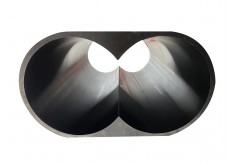 The Barrel and Screw are fundamental components in many industrial manufacturing processes, especially in plastic processing industries such as injection molding and extrusion. Together, they form the core system responsible for melting, mixing, and conveying raw materials into a usable form. The efficiency, consistency, and quality of the final product depend heavily on how well these two components work together.
What Is a Barrel?
The barrel is a cylindrical housing designed to contain the screw and withstand high temperatures and pressures during operation. It plays a critical role in maintaining thermal stability while the material is being processed. Heating elements are typically installed around the barrel to ensure that raw materials, often plastic granules, reach the required melting temperature. The internal surface of the barrel is engineered to resist wear and corrosion, as it is constantly exposed to friction and abrasive materials.
The Function of the Screw
The screw is a rotating component positioned inside the barrel, designed to move material forward while applying mechanical energy. As it rotates, the screw compresses, melts, and homogenizes the material. The design of the screw directly influences how efficiently the material is processed. Variations in screw geometry can affect melting rate, pressure buildup, and mixing quality, making the screw a highly customized component for different applications.
How Barrel and Screw Work Together
The interaction between the barrel and screw is what enables effective material processing. As the screw rotates within the heated barrel, raw material is gradually transformed from a solid state into a molten, uniform mixture. This coordinated action ensures consistent material flow and stable processing conditions. Any mismatch between the barrel and screw, such as improper clearances or incompatible materials, can lead to defects, reduced output, or equipment damage.
Both the barrel and screw are manufactured from high-strength alloys to endure extreme operating conditions. Over time, exposure to heat, pressure, and abrasive fillers can cause wear. Advanced surface treatments and coatings are often applied to extend service life and maintain performance. Selecting the right material combination is essential for minimizing downtime and ensuring long-term reliability.
The performance of the barrel and screw has a direct impact on product quality. Uniform melting and consistent pressure help prevent defects such as uneven texture, weak structural integrity, or discoloration. Well-designed components also improve energy efficiency and reduce material waste, making them crucial for cost-effective production.
Conclusion
The barrel and screw may appear to be simple mechanical components, but their role in manufacturing is highly complex and essential. By working together to control heat, pressure, and material flow, they form the backbone of many industrial processes. Proper design, maintenance, and selection of these components ensure efficient operation and high-quality output across a wide range of applications.
Prev News Next News- Information
- What are the reasons for the unstable dimensions of the profiles during the extrusion process? What are the solutions?
- What is the forming process of plastic-steel profiles? What are the key issues during forming compared to conventional profiles?
- What are the causes of the brittleness of extruded PVC profiles? And what are the solutions?
- What are the strategies to improve dimensional and geometric accuracy in profile production?
- How should a worn barrel be repaired?
- How should the counter-rotating twin-screw extruder be operated during no-load testing?
- How can internal stress concentration in profile cross-section design be minimized as much as possible?
- How can internal stress concentration in profile cross-section design be minimized as much as possible?
- What are the requirements for molding equipment and process control when producing APET sheet?
- How to enhance the low-temperature impact resistance and aging resistance of PP pipe materials?
- Contact Us

-
Shanghai Omega Machinery Co., Ltd.
Add.: No.168 Hualian Road, Putuo District, Shanghai City
Contact: Nina
Tel.: +86-021-69921527
Mobile: +86-15021464410
Fax: +86-021-69921567
E-mail: omegajessica@163.com;965425705@qq.com
WeChat No.: 1131449532
Whatsapp: +86 159 0054 6558

-